

Living in Toronto, Niagara Falls often feels like that famous neighbor you’ve known forever but rarely actually “visit.” For those of us based in the GTA, it’s the default destination when family comes to town or when you just need to get out of the city for a day. However, as a designer and an amateur photographer, I’ve found that my relationship with the Falls has changed over the years. I no longer go for the neon lights or the haunted houses of Clifton Hill; I go for the scale, the light, and that specific, thunderous hum that you can feel in your chest before you even see the water.
Recently, I decided to head down the QEW with a specific goal: to see the Falls not as a tourist attraction, but as a landscape. I wanted to see if I could find the “real” Niagara again—the one that exists beneath the layers of souvenir shops and high-rise hotels. What I found was a reminder that even the most “cliché” places in the world can still offer a profound, singular experience if you know where to stand and when to look.
Why This Place Is Worth Visiting
There is a reason why millions of people gravitate toward this specific bend in the Niagara River every year. In a world that often feels curated and digital—something I feel acutely in my work as a web designer—Niagara Falls is unapologetically raw.
What makes it feel different in person is the physicality of it. You can see high-definition videos of the Horseshoe Falls on a 5K monitor, but you cannot replicate the way the air turns heavy with moisture as you approach. You cannot simulate the “thrum” of the ground.
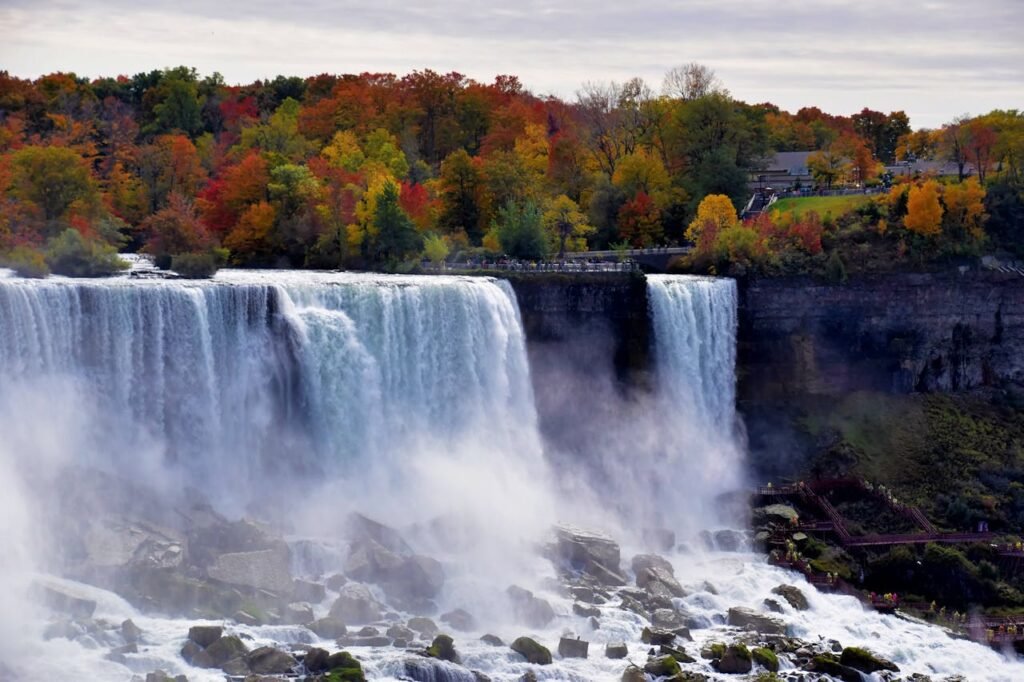
For photographers, it is a masterclass in light and movement. The way the water transitions from a deep, icy teal at the brink to a chaotic white mist at the bottom provides a color palette that is both soothing and intense. For families, it’s one of the few places where “nature” is accessible enough that you don’t need hiking boots to witness something world-class. For locals, it’s a place of perspective—a reminder of the sheer power of the Great Lakes system that we often take for granted.
What to know Before Visiting (From Experience)
If you’re planning a trip, there are a few practicalities I’ve learned through trial and error that don’t always make it into the brochures.
The Mist Factor: If you are bringing a camera, bring a microfiber cloth (or five). The “mist” is more like a localized rainstorm. If the wind is blowing toward the Canadian side, your lens will be covered in droplets within seconds.
The Best Time: Everyone says “go early,” but I actually prefer the “Golden Hour” just before sunset. The light hits the mist and creates rainbows that are far more vivid than those in the midday sun. If you can stay for the “Blue Hour”—that period just after the sun goes down but before it’s pitch black—the illumination on the Falls looks ethereal rather than just “neon.”
Crowd Management: Expect crowds. Even on a random Tuesday in the shoulder season, you won’t be alone. The trick is to walk further south, past the Table Rock Centre. Most people cluster right at the brink of the Horseshoe Falls; if you walk just ten minutes toward the Dufferin Islands, the noise of the people fades, leaving only the noise of the water.
A Small Inconvenience: The cost of parking can be jarring. You might see lots charging $35 or even $50 on a busy weekend. I’ve found that parking slightly further away near the Rapidsview lot and taking the WEGO shuttle is often easier on the wallet and less stressful for the nerves.
One Thing I Wish I Knew Earlier: Don’t eat on Clifton Hill if you value your budget or your palate. There are incredible local spots just a ten-minute drive away in the “real” city of Niagara Falls or further down in Niagara-on-the-Lake.
Getting There (Local Perspective)
Coming from Toronto, you have a few options, and I’ve tried them all.
- Driving (My Recommendation): Driving gives you the most flexibility, especially if you want to catch the sunrise or stay late for the fireworks. The drive down the QEW is straightforward—about an hour and a half without traffic, though “without traffic” is a rare occurrence in Southern Ontario. I usually aim to leave Toronto either very early (6:30 AM) or after the morning rush.
- The GO Train: During the summer and on weekends, Metrolinx runs a seasonal “Niagara Falls” service. It’s a great way to avoid the stress of the highway, and you can bring your bike. However, the train station in Niagara is about a 30-40 minute walk from the actual Falls, so you’ll likely want to hop on a bus or an Uber once you arrive.
- The Bus: I’ve used the bus several times for day trips. It’s reliable and drops you off right in the heart of the action, but you’re tied to their schedule.
For most people, I recommend driving. It allows you to explore the Niagara Parkway, which is one of the most beautiful scenic drives in Canada, stretching all the way to Fort Erie.
My Personal Experience: Standing at the Brink
My most recent visit started at 7:00 AM. I wanted to catch the morning light before the tour buses arrived. Arriving at that hour feels like you’ve been let into a private gallery. The air was crisp, and the only other people around were a few joggers and a fellow photographer setting up a tripod.
The atmosphere at that hour is meditative. As I walked along the promenade toward Table Rock, I spent a long time just watching the water. From a design perspective, the “visual hierarchy” of the Falls is fascinating. You have the smooth, glass-like curve of the water as it tips over the edge—that split second of perfect clarity—before it shatters into chaos.
I spent most of my time at the Horseshoe Falls. There is a specific spot where you can stand right at the stone wall where the water begins its drop. If you close your eyes, the sound isn’t just a roar; it’s a vibration that you feel in your solar plexus. It’s a humbling experience. It makes the “big” problems of city life—deadlines, traffic, emails—feel remarkably small.
Compared to my expectations from years ago, the area has become much more commercialized, but the water doesn’t care. That’s the takeaway: no matter how many flashy signs they put up across the street, the natural phenomenon remains untouched and indifferent. I stayed for about four hours, long enough to see the light change and the first wave of crowds begin to fill the walkways.
Things Many Visitors Miss
If you only walk the main strip, you’re only seeing 20% of the story. Here are a few details only someone who visits frequently would notice:
The Oakes Garden Theatre: This is a stunning, formal garden located right at the foot of Clifton Hill. Most people walk right past it. It offers incredible, framed views of the American and Horseshoe Falls through classical architecture and manicured hedges. It’s the best “composed” photo spot in the city.
Dufferin Islands: Located just upriver, this is a 10-acre park of tiny islands connected by footbridges. It’s quiet, filled with turtles and birds, and feels worlds away from the tourist hub. It’s where the locals go to breathe.
The Power Station Tailrace Tunnel: This is a newer attraction, but walking through the 2,200-foot tunnel of the decommissioned Niagara Parks Power Station to emerge at the base of the river is a unique perspective. You see the engineering that allowed us to harness this power.
The “Secret” Morning Light: If you can get to the Rainbow Bridge (you don’t have to cross it, just walk near the entrance) at sunrise, you’ll see the light hitting the American Falls in a way that makes the rocks look like they’re glowing from within.
Nearby Place to Visit or Eat
After you’ve had your fill of the mist, I highly recommend leaving the immediate “Falls-view” area.
Attractions
- Niagara Glen Nature Reserve: If you’re physically able to handle stairs, descend into the gorge. The hiking trails here take you right alongside the turquoise whirlpool rapids. It’s rugged, beautiful, and the rock formations are prehistoric.
- The Butterfly Conservatory: Located a few kilometers north, it’s a climate-controlled paradise. As a photographer, it’s a great place to practice macro shots.
- Niagara-on-the-Lake (NOTL): A 20-minute drive down the Parkway. It’s a preserved 19th-century town with boutique shops and world-class wineries. It provides a sophisticated counterpoint to the high-energy vibe of the Falls.
Dining
Paris Crêpes Café: Located on Queen Street (the “downtown” area, not the tourist area). It’s an authentic French bistro. Their buckwheat galettes are fantastic, and the atmosphere is cozy and far from the “chain restaurant” feel of the hotels.
Taps Brewhouse: Also in the downtown area. They have great craft beer and an upscale pub menu. It’s where you’ll find the locals on a Friday night.
Combining these spots makes sense because it gives you a “full” picture of the region—from the raw nature of the Falls to the historical charm of NOTL and the local culture of the city itself.
Cost, Tickets & Time Needed
Cost: Seeing the Falls is free. You can walk the promenade all day without spending a cent. However, attractions add up.
Journey Behind the Falls: ~$25 CAD.
Niagara Parks Power Station: ~$30 CAD.
Parking: $20–$35 CAD for a day.
Advance Booking: If you plan on doing the boat tour (Niagara City Cruises) or Journey Behind the Falls, book in advance. The lines in the summer can be two hours long.
Time Needed: You can “see” the Falls in an hour, but to experience them, you need a full day. If you include a trip to a winery or the Glen, make it a weekend.
Is it worth the money? The attractions are well-maintained, but I find the most value in the free experiences. Walking the Parkway at dawn or dusk is worth more than any $40 ticket to an observation deck.
FREQUENTLY ASKED QUESTIONS
Before you head down the QEW to see the Falls, check out these quick answers to important travel concerns.
- Where can I rent a wheelchair in Niagara Falls? Many hotels offer rentals; check with your concierge. Within Niagara Parks, manual wheelchairs are available at Table Rock Centre, the Butterfly Conservatory, and the Floral Showhouse.
- Is there a fee to view the Falls? No, Niagara Falls is on public land within Niagara Parks, granting free access 24/7 throughout the year. Only surrounding attractions and parking require payment.
- Are the Falls illuminated every night? Indeed, the Falls are illuminated nightly throughout the year. They are consistently lit, sometimes with special colors to support charitable causes.
- Does Niagara Falls ever freeze? It’s highly improbable. While an ice bridge forms at the base, the last time the Horseshoe Falls completely froze over was over 150 years ago.
- Can the Niagara Parks Adventure/Wonder Pass be used across multiple days? Absolutely. The pass vouchers are valid for use on any number of days throughout the season. However, the WEGO bus access typically provides two consecutive days of use once activated.
- Which attraction package is ideal for families? The Wonder Pass or Adventure Pass bundles are best as they cater to all ages and include the most popular sites.
- Is a passport required for American citizens? Yes. A Passport (or Passport Card/Enhanced Driver’s License for land crossings) is necessary for everyone 16 and older.
- Do children need passports? Children under 16 only need an original birth certificate if traveling by land. By air, a passport is required for everyone.
- I have a USA visa; can I use it to enter Canada? No, a separate Canadian visa or eTA is required. Check cic.gc.ca for details.
- What will the weather be like? It varies wildly! Please check a local weather forecast shortly before your visit for the most accurate news.
- How cold does winter get? December to February highs usually hover between 2°C and -1°C. Nighttime can dip to -8°C, so bundle up for the mist and wind!
- What is the best GPS address for the Falls? 6650 Niagara River Pkwy, Niagara Falls, ON. This brings you right to the Horseshoe Falls.
- What’s the nearest parking lot? Falls Parking (Lot A) at the Table Rock Welcome Centre is the absolute closest.
- Should I make hotel reservations in advance? Yes, highly recommended. Weekends and holidays sell out fast, and “driving up” may leave you with very limited or expensive options.
- Are shops and attractions open on holidays? Yes, it is a year-round destination. The only exception is December 25th, when most Niagara Parks attractions close.
- What is VQA? It stands for Vintners Quality Alliance. It guarantees the wine is made from 100% Ontario-grown grapes and meets strict quality standards.
- Can I use a drone near the Falls? Not without a permit. You must follow Canadian Aviation Regulations, which include pilot certification and registration. Transport Canada strictly monitors the airspace over the Falls.
- What is the legal age for alcohol and casinos? You must be 19 years of age or older in Ontario.
- Why do people love Niagara Falls? It is one of nature’s most breathtaking sights. The massive water flow—millions of gallons per minute—truly earns its reputation as a natural wonder of the world.
Final Personal reflection
Niagara Falls is a place of contradictions. It is a massive, awe-inspiring natural wonder wrapped in a layer of commercial kitsch.
I would recommend this place to anyone who hasn’t seen it, but specifically to those who are willing to look past the neon. If you are a photographer, a nature lover, or someone who just needs a reminder of how powerful the natural world is, it’s a “must.” However, if you hate crowds and “tourist prices,” you might want to skip the main attractions and head straight for the Niagara Glen or the Dufferin Islands.
My honest takeaway? You don’t “visit” Niagara Falls; you witness it. It’s a place that demands you put down your phone for a second and just listen. In my work, I spend all day trying to create “visual impact” on a screen. Standing at the brink of the Horseshoe Falls, I’m reminded that nature already did it better than any of us ever could.