
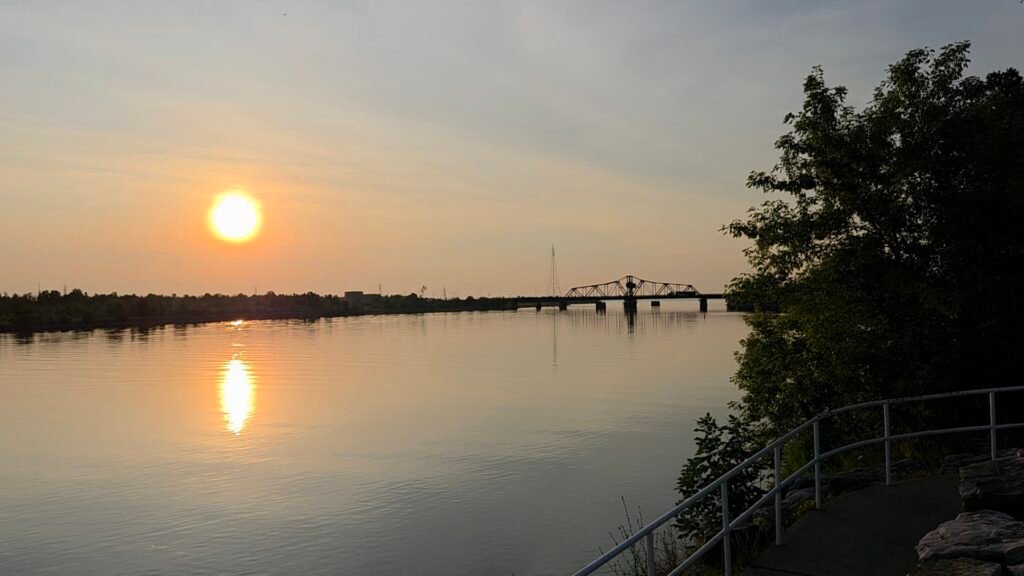
Some trips are planned down to the minute—booked months in advance, timed perfectly, and packed with expectations.
Some trips happen on impulse, born out of a sudden free weekend or a late-night idea.
And then there are journeys that feel different, Quiet, Unforced.
Almost as if they’ve been waiting patiently for the right moment—and for you.
This road trip to Manitoulin Island, the world’s largest freshwater island, felt exactly like that kind of journey.
There was no rush, no pressure to “see everything,” no rigid schedule dictating every hour of the day. What mattered most wasn’t just the destination, but the road leading to it—the pauses between places, the unplanned stops, the changing landscapes, and the gradual feeling of moving farther away from noise without ever leaving Ontario.
The trip began in Toronto, early in the day, with a full tank of gas and a car packed with the essentials: luggage, snacks, a camera, and a quiet sense of anticipation. That familiar road-trip feeling settled in—the mix of excitement and calm that only comes when you know you’re about to leave routine behind, even if just for a few days.
At that moment, Manitoulin Island wasn’t just a point on the map. It was an idea. A promise of slower mornings, open roads, and places where time doesn’t feel so tightly scheduled.
Day 1: Leaving Toronto – When the City Slowly Lets Go
Driving out of Toronto always feels symbolic, almost ceremonial.
At first, it’s the usual rhythm of city life—traffic lights changing too quickly, lanes merging and splitting, buildings standing close together as if competing for space. The familiar sounds of the city surround you: engines humming, horns in the distance, the constant movement that never truly pauses.

But gradually, almost without noticing, the city begins to loosen its grip.
Tall buildings shrink into low-rise structures. Highways open up. The skyline fades into the rearview mirror, replaced by wider skies and longer stretches of road. The traffic thins, the pace softens, and your breathing unconsciously slows along with it.
The farther north you drive, the more noticeable the change becomes.
Concrete gives way to trees. Forests begin to dominate the view, stretching endlessly on either side of the road. Lakes appear unexpectedly, catching light through gaps in the trees. Even the air feels different—cleaner, lighter, less hurried.
Highway signs start mentioning places you don’t hear about often. Names of small towns, local roads, and scenic routes replace the familiar city exits. These signs feel like quiet invitations rather than instructions, reminding you that you’re moving into a part of Ontario where life unfolds at a gentler pace.
Cell phone signals fade in and out, and instead of feeling inconvenient, it feels oddly refreshing. Notifications stop arriving. The urge to check your phone disappears. Your attention returns to the road, the scenery, and the quiet thoughts that only seem to surface when distractions fall away.
Somewhere along this drive, something subtle shifts.
You realize you’re no longer counting kilometers or checking the time. You’re no longer rushing toward the destination. You’re simply moving forward—present, relaxed, and open to whatever the road has to offer.
You’re not just leaving Toronto.
You’re arriving somewhere else entirely—even before you reach Manitoulin Island.
Sudbury: A Midway Pause with a Giant Nickel
Sudbury is one of those places many travelers pass through without a second thought. It sits comfortably along the route north, familiar enough to be recognized, yet often treated as a place to drive past rather than slow down in.
That’s exactly why stopping here felt so right.
After hours on the road, Sudbury arrived at the perfect moment—not as a destination demanding attention, but as a welcoming pause. The kind of stop that allows you to reset, refuel, and gently transition from southern Ontario’s busier rhythms into the quieter pace of the north.
What was meant to be a practical break quickly turned into one of the most memorable parts of the journey.
Lunch in Sudbury: A Simple Pause That Change the Day
By the time Sudbury appeared on the horizon, hunger had made itself impossible to ignore. The kind of hunger that only comes after long stretches of driving—where snacks help, but nothing replaces a proper meal.
Stopping for lunch here felt well-earned.
There was no rush to choose the perfect place. Sudbury has plenty of casual dining options, and that’s exactly what makes it ideal for a road trip stop. You park the car, step outside, and feel your body instantly relax as you stretch legs that have been folded for hours.
Sitting down at a table after being behind the wheel for so long feels grounding. The noise of the road fades. Conversations slow. Even the simplest food tastes better when it marks a pause rather than a delay.
Lunch in Sudbury wasn’t just about eating—it was about resetting. About giving yourself the energy and focus needed before continuing deeper into Northern Ontario, where the distances grow longer and the landscapes more immersive.
The Big Nickel: A Photo You Can’t Skip
You can’t talk about Sudbury without mentioning the Big Nickel—and seeing it in person is very different from seeing photos.
As you approach, it’s impossible not to smile.
Standing in front of the Big Nickel feels oddly impressive. It rises confidently against the sky, massive and reflective, unapologetically bold in its presence. There’s something charming about its simplicity—just a giant coin, standing there, telling a story without words.
It represents Sudbury’s mining roots, but even if you’re not particularly interested in mining history, the Big Nickel still makes sense. It’s iconic. It’s unique. And it feels distinctly Canadian in the best way possible.
This is the kind of place where road trips pause naturally. You take photos from different angles. You laugh a little at how unexpectedly large it is. You stand back, look up, and think, “Of course this exists—and of course it’s here.”
Moments like this don’t take long, but they linger in memory. Long after the drive continues, the image of that giant nickel stays with you.
Dynamic Earth: Going Beneath the Surface
Just steps away from the Big Nickel is Dynamic Earth, and while it might look like a simple museum from the outside, the experience goes much deeper—literally.
Descending underground changes the mood instantly.
The temperature drops. The air becomes cooler and heavier. The light softens, and the noise of the world above fades away. Walking through the underground tunnels gives you a real sense of scale—of how far below the surface people once worked, day after day, carving out the foundation of Sudbury’s economy.
Listening to the stories of miners and seeing the tools and spaces they used creates a powerful contrast. It’s one thing to read about mining history; it’s another to stand inside the earth and imagine the lives shaped down there.
What makes Dynamic Earth especially compelling is how balanced the experience feels. It’s informative without being overwhelming. Educational without feeling like a lecture. You learn, you imagine, and you walk away with a deeper appreciation for how strongly this land—and the people who worked it—shaped the region.
This underground experience also sets the tone for what comes next.
After spending time beneath the surface, returning to the open air feels almost symbolic. You step back into the daylight, knowing that ahead lies Manitoulin Island—wide horizons, open water, and landscapes defined not by depth, but by space.
Sudbury doesn’t demand your attention loudly.
It earns it quietly—by offering exactly what a long journey needs at exactly the right time.


The Drive Toward Manitoulin Island: Forests, Lakes, and Growing Anticipation
Leaving Sudbury, the change in scenery is almost immediate.
The road begins to feel more remote, as if it’s gently pulling you away from familiarity and deeper into Northern Ontario’s quieter heart. Traffic thins out noticeably. The constant movement of vehicles fades, replaced by long stretches of open road where you might drive several minutes without passing another car.
Trees grow thicker on both sides—tall, closely packed, and endlessly green. Forests stretch far beyond what the eye can see, creating a feeling of being surrounded rather than simply passing through. Every so often, the trees part just enough to reveal a lake—sudden, unexpected, and stunning in its simplicity.
These lakes don’t announce themselves with signs or viewpoints. They appear quietly, reflecting the sky like polished glass, mirroring clouds, sunlight, and the subtle shifts in weather. For a moment, you forget you’re driving toward a destination at all. The road becomes the experience.
This stretch of the journey is deeply peaceful.
There’s something uniquely calming about Northern Ontario roads. They don’t push you to move faster. They don’t feel impatient. Instead, they invite you to slow down—to settle into a rhythm that feels more natural and less controlled by clocks and schedules.
You drive a little slower without realizing it. You notice the way light filters through the trees, the way the road curves gently instead of sharply, the way your thoughts begin to wander freely. Conversations grow quieter. Music plays softer. The mind starts to empty in the best possible way.
This is the kind of drive where you don’t need to say much. The scenery does all the talking.
Crossing the Little Current Swing Bridge: Entering Another World
The Little Current Swing Bridge isn’t just a bridge. It’s a threshold.
As you approach it, there’s a subtle shift in energy—a quiet sense of arrival mixed with anticipation. You slow down naturally, aware that something important is about to happen. This is where the mainland ends. This is where Manitoulin Island begins.
If you arrive at the right moment, you may find yourself waiting as the bridge opens to let boats pass through. Instead of feeling like a delay, it feels almost ceremonial. Cars line up patiently. People step out, stretch, and watch the slow, deliberate movement of the bridge.
There’s something grounding about being forced to pause here.
When the bridge finally closes and you begin to cross, the moment feels significant. You look ahead and realize you’re not just changing locations—you’re changing pace.
On the other side, the atmosphere shifts almost instantly. The road feels quieter. The surroundings feel more open. Even the air seems lighter, fresher, as if the island is gently asking you to slow down and pay attention.
Manitoulin Island doesn’t announce itself loudly.
It welcomes you softly—without signs, without spectacle, just a quiet understanding that you’ve arrived somewhere different.
Checking Into the Motel: Simple, Quiet, and Exactly Right
After the long drive and the emotional transition of crossing onto the island, checking into the motel feels like a small but meaningful reward.
Accommodation on Manitoulin Island doesn’t need to impress with luxury. It needs to offer comfort, quiet, and a sense of rest—and that’s exactly what this place provided.
Booking the motel online before the trip turned out to be one of the best decisions. After hours of driving, there’s something deeply satisfying about pulling into a place where everything is already arranged. No searching. No uncertainty. Just parking the car, grabbing your bags, and stepping into a space that’s ready to welcome you.
The room was simple, clean, and thoughtfully arranged. No unnecessary distractions. No artificial noise. Just a calm, functional space designed for travelers who plan to spend their days outside and their nights resting well.
It felt less like checking into a hotel and more like settling in—knowing that tomorrow would bring exploration, but tonight was meant for slowing down.
Early Night Drive Around the Island: Soft Light and Open Roads
Instead of ending the day immediately, you chose to take a short drive around the nearby areas in the early evening—and that decision transformed the night into something quietly unforgettable.
Manitoulin Island at dusk feels almost magical.
The sky slowly shifts into soft shades of pink, orange, and lavender. Light fades gently, without urgency. The roads grow quieter with each passing minute, and the island seems to exhale as daytime activity settles into stillness.
Headlights cut softly through the dimming landscape, occasionally reflecting off a lake’s surface or the edge of a forest. The world feels larger, yet calmer—open but not overwhelming.
This isn’t a drive guided by directions or destinations. It’s guided by curiosity. You turn down roads simply because they look interesting. You don’t worry about getting lost, because getting lost here feels safe, even welcome.
There’s no rush to be anywhere. The drive itself becomes the moment.
Night on Manitoulin Island: Deep Sleep and True Silence
Sleeping on Manitoulin Island feels different from sleeping almost anywhere else.
The silence here is real—not the kind of quiet that still carries distant traffic or city hum, but a deeper, more complete silence. No sirens. No horns. No constant background noise competing for attention.
Just the quiet presence of nature.
After a full day of driving, exploring, and absorbing new landscapes, sleep arrives easily. It’s the kind of sleep that feels heavy and uninterrupted, where time seems to disappear entirely.
When you finally drift off, there’s a comforting sense of knowing that tomorrow will unfold just as slowly and naturally as today did—guided not by schedules, but by the island itself.


Day 2: Morning on Manitoulin Island – When the Island Truly Reveals Itself
Waking up on Manitoulin Island feels different from waking up anywhere else.
It’s the kind of morning that doesn’t pull you out of sleep—it gently invites you into the day.
Soft light filters through the window, unhurried and warm, as if the sun itself has decided to take things slow. The air feels cool and clean, carrying that unmistakable freshness that only comes from being surrounded by water and forest. When you step outside, even briefly, the quiet greets you like an old friend.
There’s no schedule demanding attention. No alarms pushing you forward. Just a calm sense of possibility—an open day waiting to be shaped naturally.
Breakfast is simple and unhurried. You eat without checking the time, knowing there’s nowhere you need to be immediately. The island has its own rhythm, and the best way to experience it is to follow along rather than resist.
After breakfast, the day doesn’t begin with a plan—it begins with curiosity.
Exploring Manitoulin: Slow Road, Expansive Views
Manitoulin Island isn’t a place that rewards rushing.
It reveals itself slowly, to those willing to slow down with it.
Driving across the island feels less like traveling between attractions and more like moving through a living landscape. The roads are calm and winding, encouraging you to ease off the accelerator and simply observe.
Every curve in the road seems to offer something unexpected.
A quiet lake appears suddenly, its surface perfectly still, reflecting the sky like a mirror. A forest opens up, letting sunlight spill through tall trees and onto the road. A small community emerges, modest and welcoming, with homes spaced far apart and life unfolding at an unhurried pace.
Then there are the viewpoints—those moments when you instinctively pull over, step out of the car, and just stand there. No photos at first. No words. Just a pause to take it all in.
On Manitoulin Island, the journey between places often becomes more memorable than the places themselves.
Providence Bay: Where the island Meets the Horizon
Providence Bay doesn’t try to impress—it simply exists, beautifully and confidently.
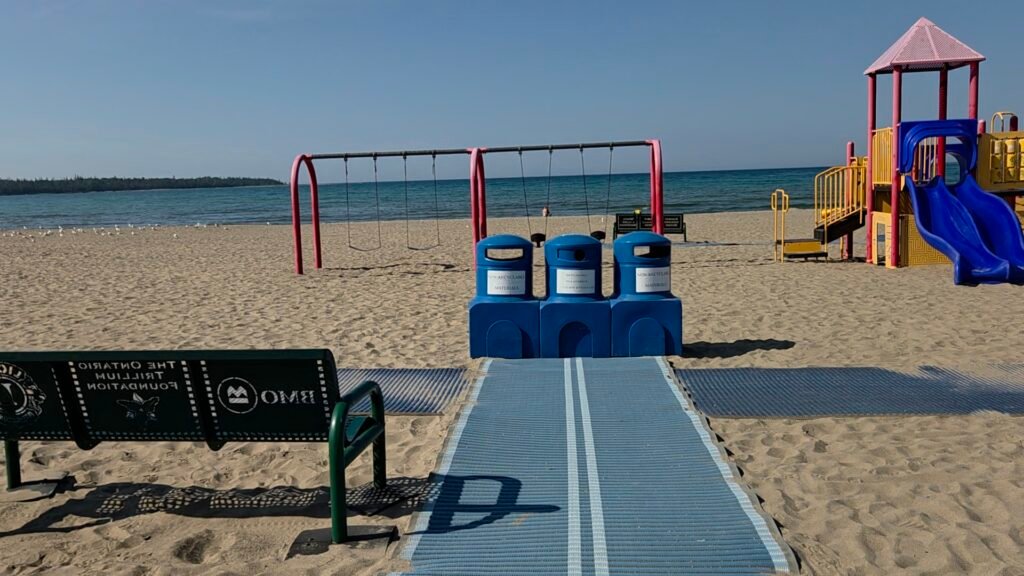
As you arrive, the openness of the beach immediately stands out. The shoreline stretches wide, giving everyone space to wander, sit, or simply stand and stare out at the water. The sand feels soft beneath your feet, warm in some places, cool in others, shaped gently by wind and waves.
Looking out over Lake Huron, it’s hard to believe this is freshwater. The lake feels endless, blending seamlessly with the horizon until water and sky seem to become one. Sunlight dances across the surface, creating shifting patterns of light that hold your attention longer than expected.
The breeze here is gentle and refreshing, carrying the scent of water and open air. People move slowly—walking, talking softly, smiling easily. There’s no urgency, no sense of crowd or competition for space.
Providence Bay is the kind of place where time quietly slips away. Minutes stretch into hours without effort. You stop thinking about what comes next and focus only on what’s right in front of you.
Lunch After the Beach: Satisfying, and Well-Earned
After spending time by the water, lunch feels especially satisfying.
There’s something about fresh air, walking along the beach, and letting your mind relax that makes even the simplest meal taste better. Hunger arrives naturally, without impatience, and sitting down to eat feels like a continuation of the experience rather than a break from it.
You eat slowly, unbothered by schedules or notifications. Conversations stay light. Thoughts drift easily. There’s no rush to finish and move on—because there’s nowhere else you need to be right now.
It’s a small moment, but one that stays with you.
Afternoon Discoveries: Letting Curiosity Lead the Way
The rest of the day unfolds without a strict plan—and that’s exactly how Manitoulin Island prefers it.
You continue exploring, guided by curiosity rather than checklists. If a road looks interesting, you follow it. If a view catches your eye, you stop. If a place invites you to linger, you listen.
Short walks lead to quiet shorelines. Small pull-offs reveal wide-open views. You sit near the water simply to watch light shift across the surface. You drive through small communities where life feels steady, familiar, and unhurried.
Nothing feels staged. Nothing feels rushed.
Every stop feels personal, as though you discovered it on your own rather than being directed there. There are no crowds pushing you forward, no signs telling you how long to stay.
Manitoulin Island doesn’t ask for your attention—it rewards it.
As the afternoon slowly fades, there’s a quiet sense of gratitude for the way the day unfolded. Not packed with activities, not overly planned—just full in the most meaningful way.
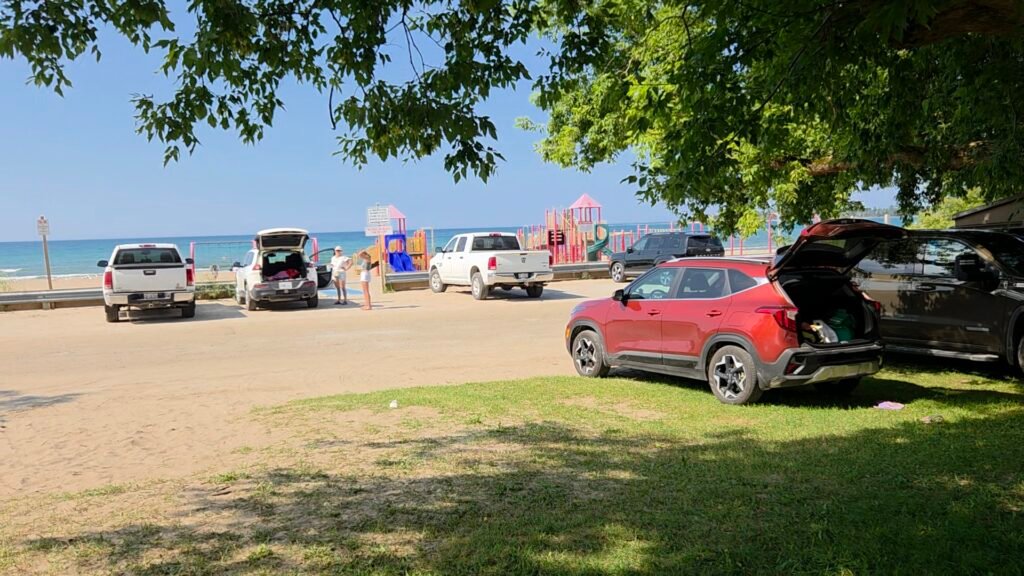
Day 3: Leaving by Water – The Chi-Cheemaun Ferry Experience
Leaving Manitoulin Island by road would have been easy. Familiar. Predictable.
But leaving by the Chi-Cheemaun Ferry transforms departure into a final experience—one that feels less like saying goodbye and more like slowly turning the page.
There’s something deeply fitting about leaving an island by water. It gives you time. Time to reflect. Time to watch the landscape change. Time to accept that the journey is shifting, even if the memories are still settling in.
This wasn’t just a way to get from one place to another. It was the final chapter of the island itself.
Boarding the Ferry: A Gentle Transition
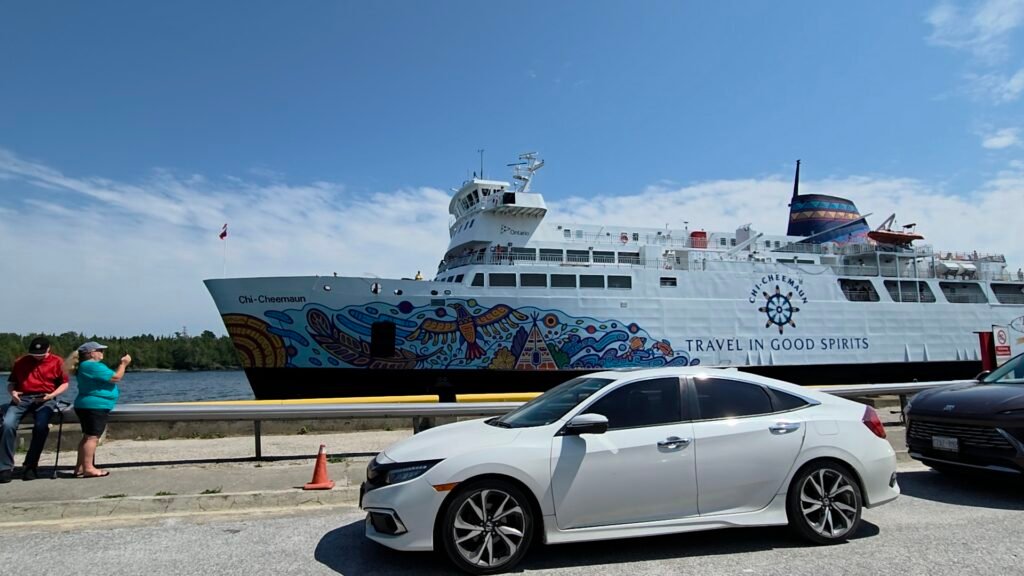
Driving toward the ferry terminal carries a different kind of energy than arriving anywhere else on the trip. There’s no rush, but there’s anticipation. Cars line up neatly, engines turn off, and people step outside as if instinctively knowing this moment deserves a pause.
Passengers stretch their legs, lean against their vehicles, and look around quietly. Conversations are soft. Cameras come out. The water sits calmly nearby, reflecting the sky in muted tones.
When it’s time to board, cars roll forward slowly, one by one, guided carefully into place. The process feels deliberate, almost respectful—nothing hurried, nothing chaotic.
As the ferry begins to move, Manitoulin Island slowly starts to drift away.
The shoreline doesn’t disappear suddenly. It lingers. Trees, land, and familiar shapes remain visible just long enough for you to take one last look.
The feeling is bittersweet—but undeniably beautiful.
On the Ferry: Wind, Water, and Quiet Reflection
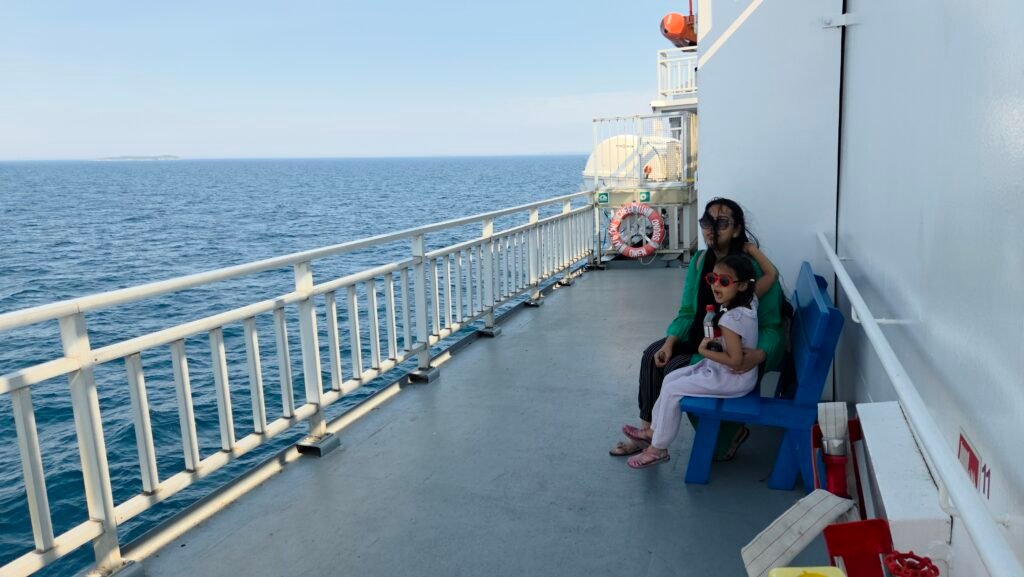
Standing on the deck of the Chi-Cheemaun Ferry is an experience in itself.
Lake Huron stretches endlessly in every direction, its vastness both humbling and calming. There’s no clear edge where water ends and sky begins—just an uninterrupted openness that invites stillness.
The wind feels cool and refreshing against your face. It carries the scent of water and distance, clearing your thoughts almost instantly. Below, the gentle movement of the lake creates a steady rhythm, a reminder that not everything needs to move quickly to keep going.
Out here, you feel small—but in a comforting way.
It’s the kind of moment that naturally leads to reflection. You think about the road that brought you here. The forests. The beaches. The quiet nights. The unexpected pauses that ended up meaning the most.
This part of the journey doesn’t demand attention. It simply offers space.
The ferry becomes a pause between two worlds—between island time and mainland life, between stillness and motion, between what was and what comes next.
This isn’t just transportation.
It’s part of the story.
Tobermory at Evening: A Perfect Ending Stop
Arriving in Tobermory as evening settles in feels like stepping into a living postcard.
The harbor glows softly under the fading light. Boats rest quietly in the water, their reflections stretching across the surface like brushstrokes. The town feels calm and welcoming, as if it knows travelers arrive here carrying both excitement and fatigue.
Dinner in Tobermory feels especially satisfying.
Warm food, comfortable seating, and a relaxed atmosphere create the perfect setting to reflect on the journey so far. Conversations are easy. Smiles come naturally. There’s a shared understanding that something meaningful has just been experienced.
It’s not a rushed stop.
It’s a gentle landing.
The Final Drive Back to Toronto: Quiet Roads, a Full Heart
Driving back to Toronto at night feels very different from leaving it days earlier.
The roads are darker, quieter, and less demanding. Headlights carve soft paths through the night. The radio plays quietly in the background, barely interrupting the steady hum of the drive.
You’re tired—but it’s the good kind of tired. The kind that comes from full days, fresh air, and moments that mattered.
Memories replay themselves naturally:
Sudbury’s unexpected charm.
The Little Current Swing Bridge.
The stillness of Providence Bay.
The ferry drifting across open water.
Reaching Toronto around midnight doesn’t feel like an ending. It feels like closing a well-written chapter—one that you know you’ll return to in memory again and again.
Final Thoughts: Why This Trip Stays With You
This journey was never about luxury or speed. It was about slowing down.
About noticing details.
About letting Ontario reveal itself in quiet, unexpected ways.
From Toronto to Sudbury, across Manitoulin Island, and back through Tobermory, every moment felt earned. Nothing was rushed. Nothing felt forced. The trip unfolded naturally, guided by curiosity rather than obligation.
Manitoulin Island doesn’t compete for attention.
It doesn’t overwhelm.
It doesn’t rush you.
It simply stays with you—long after the road leads you home.
Frequently Asked Questions (FAQ):
- Where is Manitoulin Island located?
Manitoulin Island is in Lake Huron, Northern Ontario. It’s the largest freshwater island in the world and can be reached by road via the Little Current Swing Bridge or by ferry from Tobermory.
- How far is Manitoulin Island from Toronto?
The drive from Toronto to Manitoulin Island takes about 6 to 7 hours ( 600 Km ) , depending on traffic, stops, and route.
- What is the best way to get to Manitoulin Island?
You can drive through Sudbury and cross the Little Current Swing Bridge, or take the Chi-Cheemaun Ferry from Tobermory. Many travelers combine both for a loop trip.
- Do I need to book the Chi-Cheemaun Ferry in advance?
Yes, advance booking is strongly recommended, especially during summer and long weekends, as vehicle spaces are limited.
- When is the best time to visit Manitoulin Island?
The best time is late spring to early fall (May to September), when roads are clear, attractions are open, and ferry service is running regularly.
- How many days are enough for Manitoulin Island?
Two to three days is ideal for a relaxed visit, allowing time for beaches, scenic drives, and small community stops.
- Is Manitoulin Island good for a road trip?
Absolutely. Manitoulin Island is perfect for a slow, scenic road trip, with quiet roads, open views, and frequent places to stop and explore.
- Are there beaches on Manitoulin Island?
Yes. Providence Bay Beach is the most popular, offering soft sand, wide shoreline, and beautiful lake views.
- Is Manitoulin Island crowded?
No. Even in peak season, the island feels peaceful and uncrowded, especially compared to major tourist destinations in Ontario.
- Are there places to stay on Manitoulin Island?
Yes. You’ll find motels, inns, lodges, and cottages across the island. Booking in advance is recommended during summer.
- Is Manitoulin Island suitable for families?
Yes. The island is family-friendly, with safe beaches, easy hikes, and calm driving routes.
- Can I visit Manitoulin Island without a car?
It’s possible, but having a car is highly recommended to explore the island properly, as attractions are spread out.
- Is the Little Current Swing Bridge open all the time?
Yes, but it opens periodically for boat traffic, which may cause short waits.
- What makes Manitoulin Island special?
Its natural beauty, quiet pace, freshwater beaches, and peaceful atmosphere make it feel like a world away from busy city life.
- Is this trip suitable for first-time visitors to Northern Ontario?
Yes. This route offers a gentle introduction to Northern Ontario, combining comfort, scenery, and manageable driving distances.
Before You Go: Practical Tips for a Smooth Manitoulin Island Trip
-
Fuel up early: Gas stations are less frequent once you leave Sudbury. Always refuel when you can.
-
Download offline maps: Cell service can be limited on parts of the island.
-
Book accommodations ahead: Motels and lodges fill up quickly in summer.
-
Check ferry schedules: The Chi-Cheemaun Ferry operates seasonally and runs on a fixed schedule.
-
Arrive early for the ferry: Boarding starts well before departure, especially if you have a vehicle.
-
Drive carefully at dusk: Wildlife is common, particularly deer near forested roads.
-
Slow down and enjoy: This trip is best experienced without rushing or overplanning.
Estimated Budget & Fuel Cost (Toronto → Sudbury → Manitoulin → Tobermory → Toronto)
Costs may vary depending on season, fuel prices, and travel style.
Fuel Cost
-
Total distance (loop route): ~1,100–1,250 km
-
Estimated fuel cost: CAD $150–$220
Accommodation
-
Motel on Manitoulin Island (1 night): CAD $120–$200
-
Optional second night: CAD $120–$220
Food
-
Casual meals & snacks: CAD $40–$70 per person per day
Attractions
-
Dynamic Earth (Sudbury): Paid attraction
-
Beaches & scenic stops: Free
Chi-Cheemaun Ferry (Vehicle + Passenger)
-
Approximate cost: CAD $60–$90 (varies by vehicle size & season)
Estimated total trip budget (2–3 days): CAD $450–$750 per person
What to Pack for a Manitoulin Island Road Trip
Essentials
-
Driver’s license, vehicle documents
-
Ferry booking confirmation (printed or digital)
-
Offline maps or GPS
-
Sunglasses & sunscreen
Clothing
-
Comfortable walking shoes
-
Light jacket (evenings can be cool)
-
Beachwear & towel
-
Casual, layered clothing
Road Trip Extras
-
Reusable water bottle
-
Snacks for long drives
-
Power bank or car charger
-
Camera or phone with storage space
Optional but Useful
-
Binoculars (for lake views & wildlife)
-
Small picnic blanket
-
Bug spray (especially near water)
-
Notebook or journal for reflections
Final Tip for First-Time Visitors
- Manitoulin Island rewards travelers who slow down.
- Leave space in your schedule.
- Stop when something catches your eye.
- Let the island guide the experience.